
GCC Market Entry: A Practical 90-Day Playbook (How-To)
If you’re entering the GCC (or trying to stop bleeding time and money inside it), the fastest wins come from doing the boring basics properly: pick the right country first, validate demand with real buyer conversations, then build a compliant route-to-market that can actually deliver. Who this is for: Industrial/technical companies selling project-based solutions (equipment, services, engineering, HSE, infrastructure) Teams entering the GCC for the first time, or already selling but stuck in “random acts of business development”
MARKET EXPANSION STRATEGYMARKET ENTRY STRATEGY CONSULTINGBUSINESS DEVELOPMENT CONSULTINGGCC
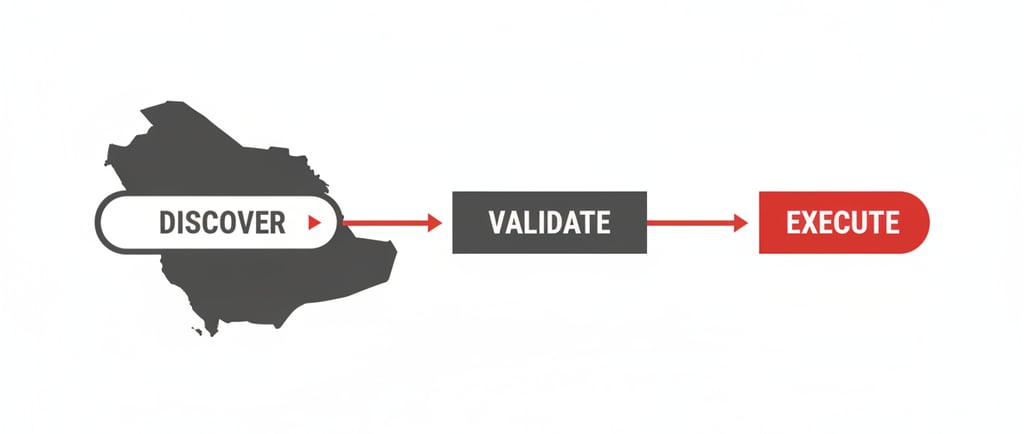
Step 1 (Days 1–14): Choose the right GCC country first
The GCC is not one market. Treat it like six distinct plays.
How to do it
Pick one “beachhead” country (usually UAE or Saudi, but not always).
Define your Ideal Customer Profile (ICP) in one sentence:
Industry + buyer role + use case + project size + compliance constraints.
Score each country against the same criteria:
Concentration of target end users / EPCs
Speed of procurement and payment behavior
Regulatory/compliance burden for your category
Need for local presence vs ability to sell cross-border
Partner availability (distributors, integrators, service firms)
Output you want
1-page “Country Selection Scorecard” with a clear #1 and #2 target
Step 2 (Days 15–35): Validate demand with real conversations (not opinions)
Most market entry failures happen because companies confuse interest with budgeted demand.
How to do it
Build a list of 30 target accounts:
10 end users
10 EPC/PMC/consultants
10 distributors/system integrators
Run 15 discovery calls using a fixed script:
What triggers a project like this?
Who writes the spec?
What standards are non-negotiable?
What’s the typical approval chain?
Who are the incumbents and why do they win?
Track answers in a simple table:
Segment, use case, budget range, timeline, spec owner, incumbent, next step
Output you want
A validated “Top 3 Use Cases” list + a shortlist of 10 accounts worth pursuing immediately
Step 3 (Days 36–60): Pick your route-to-market (RTM) model
Your RTM is a delivery decision as much as a sales decision.
Common GCC RTM options
Direct export + local service partner (fastest to test)
Distributor / system integrator (coverage, but you must control qualification)
Local entity (more control; higher fixed cost)
How to do it
Decide what you must control:
Technical qualification, pricing, compliance documents, commissioning/service
Write a partner scorecard (don’t skip this):
End-user relationships (named), sector focus, technical capability, service footprint, tender discipline
Run a 30-day partner trial:
Joint visits, shared pipeline review, one proposal together
Output you want
RTM decision + partner shortlist + written rules of engagement (who does what)
Step 4 (Days 61–90): Build a GCC-ready sales execution system
This is where deals start moving.
How to do it
Create a 6-stage pipeline with exit criteria (no vibes):
Target Qualified Site/Technical Proposal Negotiation Close
Build a GCC compliance pack (minimum viable):
Company profile, references, certifications, QA/QC, HSE, key datasheets, test reports
Run a weekly cadence:
Pipeline review (30 min)
Partner review (30 min)
Proposal review (30 min)
Output you want
90-day pipeline with named opportunities, owners, and next actions
Common mistakes (and how to avoid them)
Trying to “do GCC” instead of one country first → pick a beachhead.
Hiring a distributor before you understand the buying process → validate first.
Letting partners own the customer → you own qualification and deal strategy.
Ignoring compliance until tender time → build the pack early.
Quick checklist (copy/paste)
Beachhead country selected
30 target accounts built
15 discovery calls completed
Top 3 use cases validated
RTM model chosen
Partner scorecard used - Available at www.ventired.com
Compliance pack drafted
Weekly cadence running
Want the blunt truth?
If you’re not getting traction in the GCC, it’s usually not “the market.” It’s your focus, your qualification discipline, or your partner control. If you want help fixing those and get in touch sales@ventired.com
International Sales Consulting for industrial manufacturers entering GCC and EMEA markets. Dubai-based. Globally proven.
+971-4-501-1360
© 2026. Venti Red Fz-LLC. All rights reserved.

PO Box (Dubai) 338482, Platinum Tower (Cluster I), Jumeriah Lake Towers, Dubai, UAE
ADNOC Vendor Approval
EPC Contractor Strategy
SERVICES
MARKETS
COMPANY
UAE & ADNOC
Saudi Arabia & Aramco
EMEA Experts
EPC Contractors
About us
FAQ
Contact